Designing Connected Ecosystems
Transforming a transportation network into two focused digital platforms tailored to the distinct needs of businesses and travelers.
00

problem
A transportation hub company needed to redesign its digital presence while serving two fundamentally different audiences: businesses searching for commercial opportunities and end users looking for practical station information and travel services. The existing approach attempted to support both audiences within a single platform, creating conflicts in information architecture, content hierarchy and conversion goals. As a result, neither audience was being served effectively, generating confusion and reducing overall usability and business impact.
solution
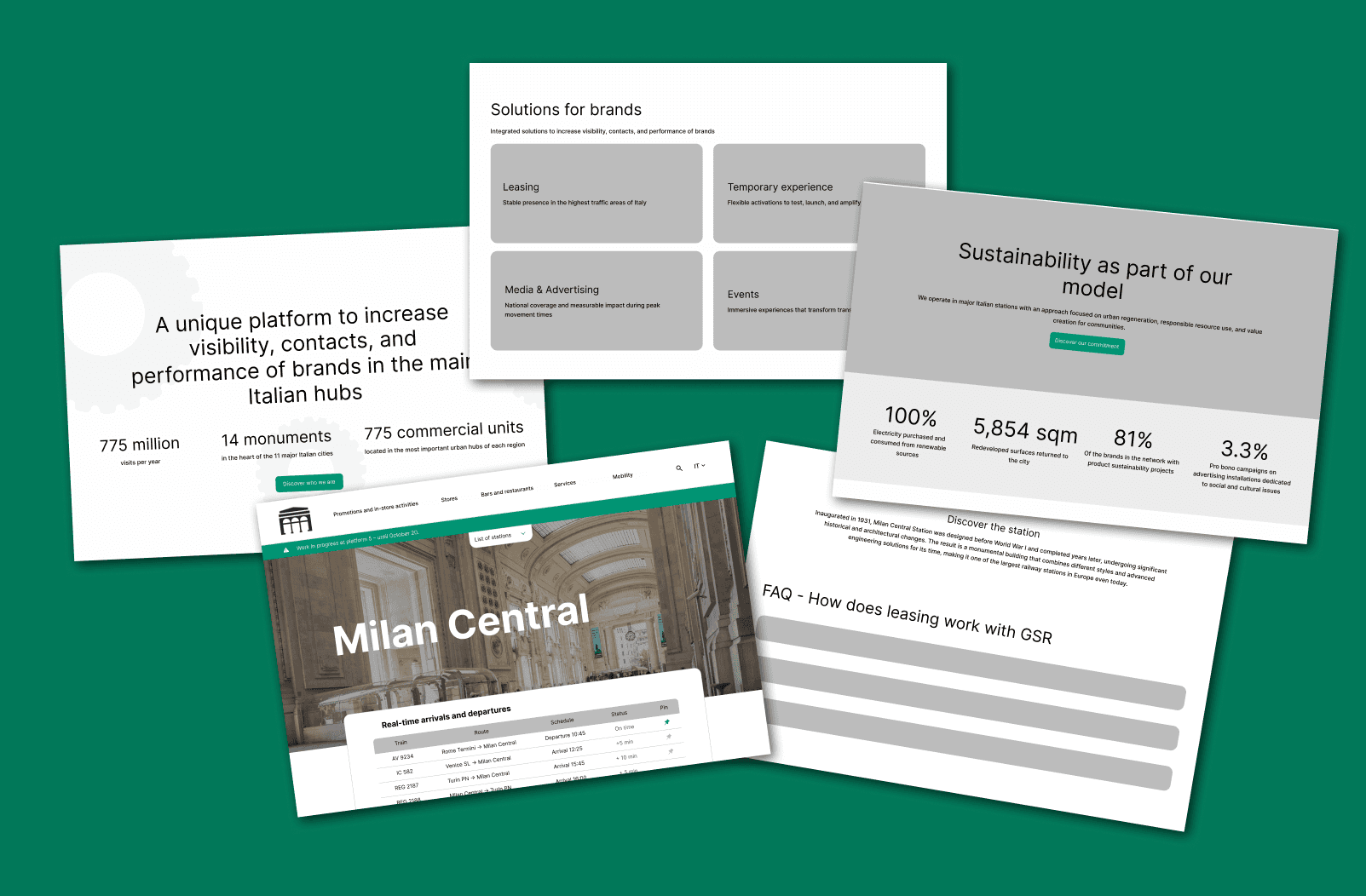
After conducting a strategic benchmark analysis, I defined a dual-platform ecosystem designed to separate business and consumer needs into two focused experiences with distinct objectives and structures. The B2B platform was designed as a commercial hub centered around space availability, business opportunities and lead generation, while the B2C experience evolved into a network of station-specific websites providing contextual and practical information for travelers in real time.
Collaboration & Process
As the sole Product Designer on the project, I worked across the entire process from strategic definition to wireframe delivery. This included defining the information architecture for both platforms, designing key user flows and ensuring alignment between business objectives and user needs throughout the experience.
One of the most important parts of the process was recognizing that the core issue could not be solved through interface improvements alone. The project required an architectural shift in how the ecosystem itself was structured, redefining the relationship between audiences, content and platform goals rather than simply reorganizing screens.
Key Learnings
One of the biggest learnings from the project was understanding how strongly information architecture influences both usability and conversion. When audiences have fundamentally different goals, forcing them into a shared structure often weakens the experience for everyone involved.
The project also reinforced the importance of contextual prioritization. Business users required clear value communication and direct conversion paths, while travelers needed immediate access to relevant information under time-sensitive conditions. Designing effectively meant optimizing each experience around the specific behaviors and expectations of its audience.
year
2026
timeframe
2 Months
tools
Figma
category
UX
01

02

see also